
When it comes to concrete work, the choice of cement is the foundation of quality, strength, and long-term durability. Whether you’re building a house, a commercial structure, or an infrastructure project, using the best cement for concrete work determines how your structure performs for decades.
With so many cement types and brands available in India—OPC, PPC, PSC, and composite blends—it’s easy to feel overwhelmed. In this comprehensive guide, Chettinad Cement’s experts break down everything you need to know to choose the right cement for every kind of concrete work, and why Chettinad’s advanced formulations are trusted across South India for strength and reliability.
Why the Right Cement Matters for Concrete Work?
Concrete is a mix of cement, aggregates, sand, and water. But not all cement types behave the same way.
The right cement can mean:
- Higher compressive strength
- Better workability and finish
- Improved resistance to cracks and sulphates
- Faster setting time for faster project delivery
- Enhanced durability in coastal or humid climates
Using the wrong cement can cause weak bonding, surface cracks, and reduced life span. That’s why understanding your project’s specific concrete requirements is key.
Types of Cement Commonly Used in Concrete Work
In India, several types of cement are used in concrete mixes. Here’s a quick comparison:
| Cement Type | Description | Ideal Use in Concrete Work |
|---|---|---|
| OPC (Ordinary Portland Cement) – 33/43/53 Grade | High early strength and fast setting | RCC, beams, slabs, foundations |
| PPC (Portland Pozzolana Cement) | Blend of clinker and fly ash – durable, less heat of hydration | Large pours, residential slabs, mass concrete |
| PSC (Portland Slag Cement) | Blended with slag for better chemical resistance | Coastal, marine, or underground concrete works |
| Composite Cement | Mix of fly ash + slag for superior performance | General concrete work needing strength & sustainability |
What Makes Cement “Best” for Concrete Work?
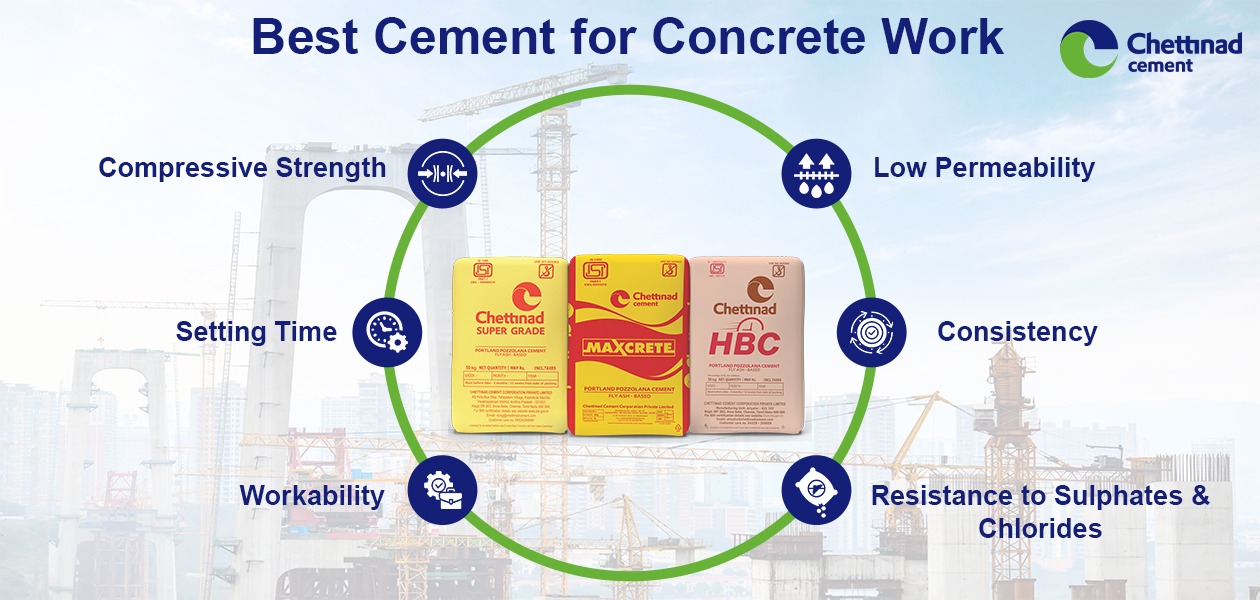
To identify the best cement for concrete, engineers and builders look for:
- Compressive Strength: Determines load-bearing capacity.
- Setting Time: Faster setting for precast; moderate for mass pours.
- Workability: Smooth mixing and placing of concrete.
- Low Permeability: Prevents moisture ingress and corrosion.
- Consistency: Uniform performance across batches.
- Resistance to Sulphates & Chlorides: Essential for coastal and industrial areas.
A cement that balances all of these properties is ideal for high-quality concrete work.
Why Chettinad Cement Excels in Concrete Applications?
Chettinad Cement has been a trusted partner in South India’s construction industry for over five decades. Our state-of-the-art manufacturing and rigorous quality systems ensure every bag delivers consistent strength, superior bonding, and long-term durability.
Here’s why Chettinad Cement stands out for concrete work:
a) MAXCRETE Premium PPC
- High early strength ideal for RCC, slabs, and precast work
- Quick setting time to enable faster formwork removal
- Creates dense, impermeable concrete that resists cracking
- Excellent finish and workability for smooth surfaces
👉 Perfect for: RCC beams, slabs, columns, and general concrete work.
b) Chettinad Composite Cement
- Combines the benefits of fly ash and slag
- Enhances long-term strength and durability
- Ideal for sustainable construction with reduced CO₂ footprint
- Excellent for large pours and exposed concrete
👉 Perfect for: Residential and commercial buildings, large concrete works.
c) Super Grade PPC Cement
- Designed for mass concrete works like foundations, dams, and retaining walls
- Offers low heat of hydration, minimizing thermal cracks
- Provides superior chemical resistance against sulphates and chlorides
👉 Perfect for: Coastal and heavy infrastructure projects.
Quick Comparison Table
| Concrete Work Type | Recommended Chettinad Cement | Key Benefits |
|---|---|---|
| RCC beams & slabs | MAXCRETE Premium PPC | High early strength, dense concrete |
| Foundations | Super Grade PPC | Low heat of hydration, durability |
| Coastal / Marine | PSC or Composite Cement | Resistance to sulphates, corrosion |
| Precast / Fast-track | MAXCRETE | Fast setting, smooth finish |
| General Residential | Composite Cement | Workability + strength balance |
How to Choose the Right Cement for Your Concrete Work?
Follow these 5 steps before buying your cement:
- Identify your structure type – slab, beam, foundation, column, etc.
- Consider your environment – coastal, industrial, or inland.
- Check project timeline – if speed matters, choose high-early-strength cement.
- Confirm quality – always buy ISI-certified cement with clear batch details.
- Consult experts – Chettinad Cement’s technical team can recommend the best product for your site conditions.
Common Mistakes to Avoid in Concrete Work?
Even the best cement can fail if handled poorly. Avoid these mistakes:
- Using too much water in the mix
- Improper curing (less than 7 days)
- Mixing old and new bags of cement
- Storing cement in humid environments
- Ignoring mix design proportions
Chettinad Cement ensures every batch meets strict standards—but your on-site practices complete the picture of quality.
Real-World Performance: Chettinad Cement in Action?
Chettinad Cement has powered concrete works for major infrastructure and residential projects across Tamil Nadu, Karnataka, Andhra Pradesh, and Kerala.
Our cement has been used in:
- Bridges and Flyovers – requiring high early strength and low permeability
- Industrial Foundations – where sulphate resistance is vital
- Residential Towers – for aesthetic, durable finishes
FAQs: Best Cement for Concrete Work?
Q1. Which is the best cement for RCC concrete?
👉 Chettinad MAXCRETE Premium PPC — provides high early strength and superior bonding.
Q2. Is PPC cement suitable for concrete slabs?
Yes, PPC offers good workability and finish; Chettinad PPC also provides dense, impermeable concrete ideal for slabs.
Q3. What cement should I use for coastal concrete work?
Chettinad Composite or PSC Cement — designed for sulphate and chloride resistance.
Q4. How do I ensure the concrete mix achieves full strength?
Follow the correct water-cement ratio, proper curing (at least 7 days), and ensure fresh cement is used.
Q5. Where can I buy Chettinad Cement near me?
Visit chettinadcement.com/contact or your nearest authorized dealer.
Conclusion
Choosing the best cement for concrete work is not just about brand—it’s about matching the right cement type to your project needs.
With Chettinad Cement’s range of high-performance products, you get the perfect blend of strength, workability, and durability—no matter what your concrete challenge is.